Indexing & Archiving
- Sherpa/Romeo ORCID (Signatory Publisher) iThenticate - Plagiarism Checker CrossRef Meta Data User - Indexing J Gate Indexed - Indexing DORA - San Francisco Declaration on Research Assessment Portico - Archiving BASE (Bielefeld Academic Search Engine) - Indexing Scilit - Indexing Open Archives Initiative - Indexing CNKI-Archiving Index Copernicus - Indexing (Underevaluation) TDNet - Indexing HOLLIS catalog tool - Powered by Harward Library GrowKudos-Indexing Dimensions Academic Microsoft ScienceOpen




Abstract
 Open Access Research Article
Article ID: GJCT-12-156
Open Access Research Article
Article ID: GJCT-12-156
Beyond Troponins: Emerging Biomarkers for Early Detection of Chemotherapy-Induced Cardiotoxicity in Breast Cancer
Themelidi Vasiliki*, Vlachou Maria, Varvarelis Orfeas-Petros, Ioakeim Kalliopi, Kampouroglou Effrosyni and Tsekoura Dorothea
Although modern breast cancer therapies have significantly improved long-term survival, reliable tools for the early detection and prediction of Cancer Therapy-Related Cardiac Dysfunction (CTRCD) remain essential. Cardiovascular toxicity encompasses a broad spectrum of manifestations, ranging from asymptomatic myocardial dysfunction to heart failure, ischemic heart disease, valvular abnormalities, arrhythmias, hypertension, and thromboembolic events.
Anthracyclines and radiation therapy are the most well-established cardiotoxic treatments. Anthracycline-induced cardiotoxicity demonstrates a dose-dependent and often irreversible pattern (Type I cardiotoxicity), primarily mediated by oxidative stress and mitochondrial injury. In contrast, HER-2 targeted therapies are associated with reversible myocardial dysfunction (Type II cardiotoxicity), mainly through the disruption of the ErbB2 signaling pathway. Newer therapies, including anti-VEGF agents and endocrine therapies combined with CDK4/6 inhibitors, further expand the spectrum of cardiovascular risks.
Current guidelines support the use of left ventricular ejection fraction, troponins, and natriuretic peptides for cardiotoxicity monitoring. However, emerging biomarkers, including myeloperoxidase, matrix metalloproteinases, galectin-3, inflammatory markers, and microRNAs, have shown potential for the early detection of myocardial injury.
This review summarizes the current evidence regarding the mechanisms, clinical features, and risk factors of cardiotoxicity associated with breast cancer therapy. It further evaluates both established and novel biomarkers and highlights the clinical value of integrating them with advanced imaging modalities to improve the early detection and monitoring of cardiac remodeling. Further research is required to validate these approaches for clinical use (Graphical abstract).
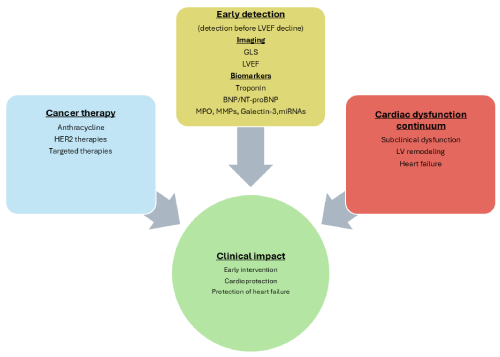
Graphical abstract: Integrated multimodal approach for the early detection of Cancer Therapy-Related Cardiac Dysfunction. Cancer therapies trigger myocardial injury through multiple mechanisms. Combined use of cardiac biomarkers and advanced imaging modalities, particularly global longitudinal strain, enables detection of subclinical dysfunction before a decline in left ventricular ejection fraction. Early identification allows for timely cardioprotective interventions and prevention of progression to heart failure.
Keywords:
Published on: May 29, 2026 Pages: 4-19
Full Text PDF
Full Text HTML
DOI: 10.17352/2581-5407.000056
CrossMark
Publons
Harvard Library HOLLIS
Search IT
Semantic Scholar
Get Citation
Base Search
Scilit
OAI-PMH
ResearchGate
Academic Microsoft
GrowKudos
Universite de Paris
UW Libraries
SJSU King Library
SJSU King Library
NUS Library
McGill
DET KGL BIBLiOTEK
JCU Discovery
Universidad De Lima
WorldCat
VU on WorldCat
Indexing/Archiving


Editor-in-Chief

|
Vingolo Enzo Maria
Sapienza University of Rome, Italy Journal of Clinical Research and Ophthalmology |

|
Stavros Dimopoulos
University of Athens, Greece Journal of Novel Physiotherapy and Physical Rehabilitation |

|
Hon. Pierre Guertin
Laval University, Canada Global Journal of Obesity, Diabetes and Metabolic Syndrome |

|
Zhongchang Wang
International Iberian Nanotechnology Laboratory (INL), Portugal International Journal of Nanomaterials, Nanotechnology and Nanomedicine |

|
Hermis Iatrou
University of Athens, Greece Open Journal of Chemistry |

|
Kwang-Hyun Baek
Yeungnam University, Korea International Journal of Immunotherapy and Cancer Research |

|
Dr. Pierre Guertin
Laval University, Canada Archive of Gerontology and Geriatrics Research |

|
Manuel Jose Lis Arias
Polytechnic University of Catalonia, Spain Archive of Biochemistry |

|
Michel BOURIN
University of Nantes, France Archives of Depression and Anxiety |

|
Giorgio Bianciardi
University of Siena, Italy International Journal of Oral and Craniofacial Science |
 NIH Funded Articles
Research Articles
May 23, 2016Usefullness of Phytoestrogens in Treatment of Arterial Hypertension. Systematic Review and Meta-Analysis: Un Update
April 12, 2016Prevalence and predictors of gastroesophageal reflux disease in pregnant women and its effects on quality of life and pregnancy outcomes
March 30, 2021

