Annals of Bone Marrow Research
An Exploratory Treatise on the Theoretical Dynamics of Hypothetical Bone Marrow Flux
Department of Speculative Haematology, Institute for Conceptual Physiology, Norway
Author and article information
Cite this as
Hunden B. An Exploratory Treatise on the Theoretical Dynamics of Hypothetical Bone Marrow Flux. Ann Bone Marrow Res. 2026; 11(1): 1-3. Available from: 10.17352/abmr.000013
Copyright License
© 2026 Hunden B. This is an open-access article distributed under the terms of the Creative Commons Attribution License, which permits unrestricted use, distribution, and reproduction in any medium, provided the original author and source are credited.Bone marrow is widely recognised as a critical site of hematopoiesis. However, the conceptual framework describing its hypothetical flux dynamics remains underdeveloped. In this article, we present a minimalist, highly theoretical model of bone marrow behaviour, introducing the construct of the “Marrow Flux Number” (MFN). Although the model is not directly calibrated to any known biological system, it provides a compact formalism that may inspire future, empirically grounded research. We explicitly discuss how the proposed framework compares with more detailed, compartment-based models, and we illustrate the influence of MFN on model trajectories with a simple graphical example. Finally, we outline conceptual links between MFN and common haematological conditions, along with potential experimental approaches to estimating MFN in practice.
Bone marrow is the principal site of adult hematopoiesis, hosting complex interactions among hematopoietic stem cells, stromal cells, and the vascular niche. While extensive efforts have characterised cellular populations, signalling pathways, and lineage commitment, there remains a lack of simple, closed-form expressions capturing the overall behaviour of marrow cell populations under steady and perturbed conditions.
Existing mathematical representations of hematopoiesis and bone marrow dynamics are often based on multi-compartment ordinary differential equation systems or agent-based models. These approaches can incorporate detailed lineage structure, cell-cycle kinetics, feedback regulation by cytokines, and spatial aspects of the niche. However, such models typically: (i) involve large numbers of parameters that are difficult to estimate from available data. (ii) require substantial numerical effort for simulation, and (iii) can render intuition about global behaviour (e.g. stability, capacity limits, and gross fluxes) opaque to non-specialists. Moreover, assumptions about compartment boundaries and transition rates may vary substantially between models, limiting direct comparability and making it challenging to derive simple summary indices of “marrow performance” or flux.
Here, we adopt a deliberately simplified, formal approach to bone marrow dynamics. Our goal is not to provide a realistic description of a particular organism, but rather to propose a compact mathematical framework that can, in principle, be parameterised by future experimental data. By reducing the system to a single effective population density and a small number of parameters, we aim to highlight fundamental relationships between proliferation, carrying capacity and efflux from the marrow, and to introduce the Marrow Flux Number as a dimensionless descriptor of this balance.
Methods
We consider a spatially homogeneous compartment representing bone marrow, within which a single effective cell population density, M(t), evolves t. We postulate that M(t) follows a logistic-like growth law with an additional linear loss term, modelling egress of mature cells into circulation:
where r is an effective proliferation rate, K is a carrying capacity, and λ is a flux parameter representing exit from the marrow space.
Under this framework, the nontrivial equilibrium M* is obtained by setting , yielding
provided r > l. We define the dimensionless Marrow Flux Number (MFN) as
Values of MFN close to 0 correspond to a proliferation-dominated marrow, whereas values approaching 1 correspond to a marrow near functional depletion.
Illustrative trajectories of M(t)
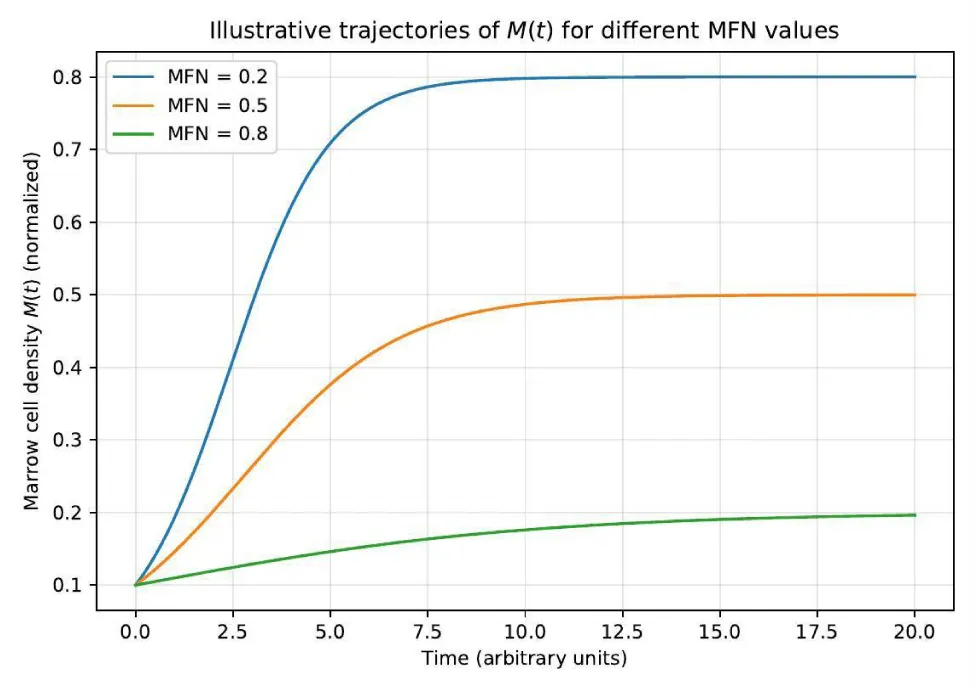
For illustration, we consider arbitrary units in which K = 1 and r = 1, and we examine the model trajectories for three representative values of MFN: MFN = 0.2 (low flux), MFN = 0.5 (intermediate flux), and MFN = 0.8 (high flux). In each case, we assume an initial condition M(0) = 0.1 Figure 1 qualitatively depicts how M(t) approaches its corresponding equilibrium over time.
Results
Analytical behaviour of the model
The equilibrium M* is positive if and only if 0 < MFN < 1. In this regime, the linearization around M* shows that the equilibrium is locally stable. The Jacobian of the system is
so that
For 0 < MFN < 1, we have J(M*) < 0, confirming local stability and a monotonic return to equilibrium after small perturbations.
Interpretation of the Marrow Flux Number
Although the present model is purely formal, MFN provides a compact descriptor of the balance between marrow cell production and efflux. High MFN (near 1) implies that effective loss from the marrow is nearly equal to the proliferative capacity, resulting in low steady-state M*. Conversely, low MFN indicates that prolifesration overwhelms loss, driving the system toward the carrying capacity K.
This construct suggests that future experimental studies, combining labelling of proliferating or pathological conditions-
Conceptual links between MFN and haematological conditions
From a conceptual standpoint. MFN can be loosely related to several common haematological patterns:
Marrow failure and cytopenias: Conditions such as aplastic anaemia or severe myelodysplastic syndromes may be characterised by decreased effective proliferation (r) and/or increased loss or ineffective output (l), yielding MFN values close to 1 and low M*.
Myeloproliferative states: In contrast, myeloproliferative neoplasms or reactive hyperproliferation could correspond to increased and relatively restrained l, resulting in low MFN and elevated M* (subject to biological constraints on K).
Stress hematopoiesis: During acute infection or haemorrhage, transient changes in proliferation and efflux might dynamically modulate MFN, leading to time-dependent shifts in M(t) that reflect emergency granulopoiesis or compensatory erythropoiesis.
These associations are qualitative and serve primarily to illustrate how MFN might, in principle, be mapped onto recognisable clinical phenotypes.
Potential experimental estimation of MFN
Estimating MFN in practice would require approximate measurements of both effective proliferation (r) and flux (λ). Several experimental approaches could be considered:
Proliferation proxies (r): Serial measurements of marrow labelling indices (e.g. Ki-67 staining, BrdU incorporation in experimental settings), combined with estimates of stem and progenitor cell pools, could provide functional proxies for r.
Efflux proxies (λ): Tracking the appearance of labelled cells in peripheral blood after marrow labelling (e.g. cytopenias, myeloproliferative states, or responses to growth factors), even if the present work does not undertake such measurementsusing deuterium-labeled glucose or other metabolic tracers) may yield information about the rate of mature cell egress, contributing to an estimate of λ.
Model-based inference: Given repeated peripheral blood counts and occasional marrow assessments under relatively stable conditions, simple inverse modelling techniques could be employed to fit r,k, and λ thereby producing an approximate MFN for individual patients or disease cohorts.
These strategies would require careful validation and are presented here solely as conceptual examples of how MFN might be linked to measurable quantities [1-3].
Discussion
We have outlined a minimal differential equation model for bone marrow cell density and introduced the Marrow Flux Number as a single parameter summarising the balance between proliferation and efflux. The framework is intentionally sparse in biological detail and should be regarded as a conceptual scaffold rather than a direct description of any particular patient, species, or disease state.
Compared with more detailed compartmental or agent-based models, the current approach trades biological fidelity for interpretability and analytic tractability. In particular, the use of a single effective population density and a logistic-like equation precludes explicit representation of lineage hierarchies, niche heterogeneity, and cell-cycle dynamics. Nonetheless, as illustrated by the trajectories in Figure 1, even such a simplified framework can clarify how basic parameters govern equilibrium levels and responses to perturbation, and can motivate the definition of dimensionless summary indices such as MFN.
A more realistic extension of this model would include at least: (i) multiple compartments (stem, progenitor, and mature cells), (ii) explicit representation of cytokine feedback and niche-mediated regulation, and (iii) spatial heterogeneity within the marrow cavity. Nevertheless, even the present model demonstrates how simple non-dimensional numbers can be defined for complex tissues, in analogy to the use of Reynolds or Damköhler numbers in fluid dynamics and chemical engineering. Future work might also explore stochastic variants of the model to capture fluctuations in small stem cell populations.
Conclusion
This short treatise presents a theoretical, dimensionless summary of bone marrow behaviour via the Marrow Flux Number. While no empirical data were used in constructing the model, the formalism highlights how even highly complex biological systems can be framed using simple equations and scaling arguments. Future work should focus on mapping experimentally accessible quantities onto the minimal parameters r,k, and λ, thereby allowing the abstract MFN to be estimated and, potentially, correlated with clinical outcomes and specific haematological conditions.
Conflicts of interest
The author declares no conflicts of interest and no funding relevant to this work.
- Morrison SJ, Scadden DT. The bone marrow niche for haematopoietic stem cells. Nature. 2014;505:327-334. Available from: https://doi.org/10.1038/nature12984
- Weissman IL. Stem cells: units of development, units of regeneration, and units in evolution. Cell. 2000;100:157-168. Available from: https://doi.org/10.1016/s0092-8674(00)81692-x
- Manz MG, Boettcher S. Emergency granulopoiesis. Nat Rev Immunol. 2014;14:302-314. Available from: https://doi.org/10.1038/nri3660



 Save to Mendeley
Article Alerts
Subscribe to our articles alerts and stay tuned.
 This work is licensed under a Creative Commons Attribution 4.0 International License.